
Speed
Stop arguing about image formats. Here is the rule.
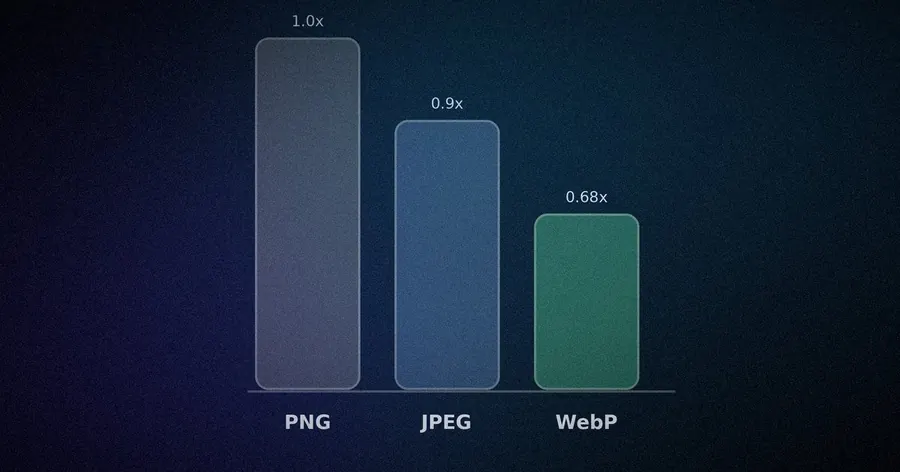
Every few months someone reopens the format debate as though it were unsettled. It is mostly settled. The confusion survives because the advice online was written when the answer was genuinely different.
The rule: use WebP for almost everything, keep PNG only when you need it, and reach for AVIF when you are optimising hard. Everything below is why.
WebP already won the compatibility argument
The old objection to WebP was support. That objection expired. In 2026 WebP sits at roughly 97 percent global browser support, and it appears on around one in five websites. Nearly every visitor you have can see it natively, with no fallback and no polyfill.
The payoff is size. WebP typically produces files 25 to 35 percent smaller than the equivalent JPEG or PNG at comparable quality. On an image-heavy page that is a third of your weight gone for no visual cost, which is the rarest kind of win in web performance.
When each format is actually right
- WebP: the default. Photographs, hero images, thumbnails, blog art, product shots. It handles both lossy and lossless, and it supports transparency, which is what makes it a genuine PNG replacement rather than just a JPEG one.
- PNG: when the pixels are the point. Screenshots with fine text, diagrams with hard edges, logos you will re-edit, anything where a compression artefact would be a defect rather than a nuisance.
- JPEG: compatibility and handoff. Photos going to a client, a print shop, an older system, or any place where you cannot control what opens the file. Universally understood, still fine.
- SVG: anything drawn rather than photographed. Icons, logos, charts. Infinitely scalable and usually tiny. Not a raster format, so it is not really in this contest.
- AVIF: the aggressive option. Smaller again than WebP, but it still represents only around one percent of images crawled and encoding is slower. Worth it on a handful of heavy pages, not worth rebuilding your whole pipeline for yet.
Format choice is worth about a third of your page weight. Dimensions are worth more.
The bigger mistake is not the format
Converting a 4000 pixel wide photo to WebP gives you a smaller 4000 pixel wide photo. If it displays in a 600 pixel column, you are still shipping roughly forty times the pixels the layout will ever use.
Resize first, then convert, then compress. In that order. Getting the dimensions right beats every format argument, and it is the step people skip because it feels less technical.
Convert without uploading anything
Turn JPEG or PNG into WebP, or back again, right in your browser. The file is never sent to a server, so there is no queue, no watermark and no wait.
Open the image converterFree, no sign-up, nothing uploaded.
A practical workflow
- Resize to the largest size it will actually display, then double it if you are serving high-density screens. Not more.
- Convert to WebP unless it is a screenshot full of small text, in which case keep PNG.
- Compress and eyeball the result at real size, not zoomed in. Artefacts you can only see at 400 percent are not artefacts your visitors will see.
- Set width and height in the HTML so the browser reserves space and the page stops jumping while images load.
- Lazy-load anything below the fold so it does not compete with the content people can actually see.
Why this matters beyond tidiness
Image weight is the single largest contributor to a slow page on most sites, and page speed feeds directly into Core Web Vitals, bounce rate and conversion. It is one of the few optimisations where the technical fix and the business result are separated by almost nothing. This piece goes deeper on the Core Web Vitals side.
Convert with the format converter, then squeeze what is left with the image compressor. Both run in the browser, so a folder of client photos never leaves your machine. Dedicated converters for each pair: JPG to WebP, PNG to WebP, WebP to JPG, WebP to PNG, PNG to JPG and JPG to PNG.
Questions people actually ask
- Is WebP supported by all browsers in 2026?
- Effectively yes. WebP has roughly 97 percent global browser support, meaning at least 97 of every 100 visitors can display it natively without a fallback.
- How much smaller is WebP than JPEG?
- Typically 25 to 35 percent smaller at comparable visual quality, though the exact saving depends on the image. Photographs with smooth gradients tend to benefit most.
- Should I switch to AVIF instead?
- AVIF compresses better than WebP but still accounts for only around one percent of images on the web, and encoding is slower. It is worth using on a few heavy pages rather than as a wholesale replacement right now.
- When should I still use PNG?
- When precision matters more than size: screenshots containing small text, diagrams with sharp edges, and source images you intend to edit again. PNG is lossless, so nothing degrades.
- Does converting to WebP lose quality?
- Lossy WebP discards some data, like JPEG, but usually less visibly at the same file size. WebP also has a lossless mode if you need an exact reproduction with transparency.
Written by Sourav Mahapatra, who builds BeginThings: free browser tools and BeginRooms, a 3D workspace you can walk through. Take the 30-second tour or start a free 15-day trial, no card needed.